Germany news: Merz issues business SOS in letter to allies
Published January 6, 2026last updated January 6, 2026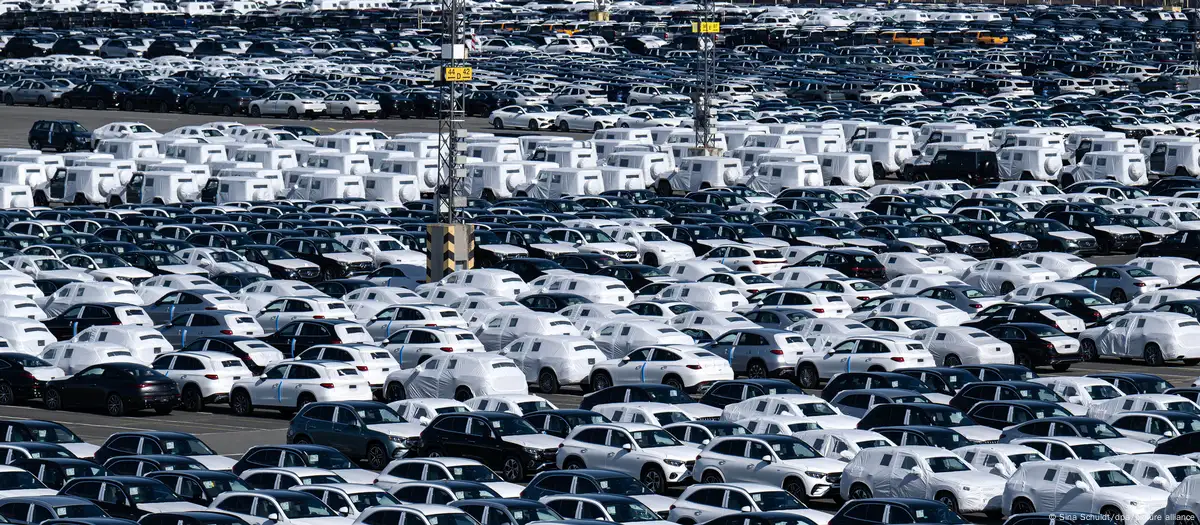
What you need to know
- Friedrich Merz sounds alarm on business competitiveness in New Year's letter to coalition partners
- Thousands remain without power in Berlin in freezing temperatures after power cable sabotage
- The coalition government in Brandenburg state has collapsed amid the disintegration of its junior partner party, the far-left BSW
This blog is now closed. Read below for a roundup of news in Germanyon January 6.
Conservative CSU's annual retreat mulls sending Ukrainian, Syrian men home
Conservatives in Germany want to continue their tough stance on migration in 2026.
Speaking at his party's annual political kick-off in Seeon, Bavarian Premier Markus Söder of the conservative Christian Social Union (CSU) in Bavaria said young Ukrainian men will now be increasingly urged to leave Germany.
Conservatives have called for further measures to curb migration to Germany, especially after the number of first-time asylum applications in Germany more than halved in 2025. Young men from countries such as Syria and Ukraine will be encouraged to return.
It is striking that Söder is raising the issue in the context of the debate about the possible deployment of European troops to Ukraine for peacekeeping purposes.
"Before young German men have to go to Ukraine, young Ukrainian men should first return home and help defend their own country," the CSU leader said, rejecting the deployment of German soldiers there, at least for the time being.
It is no coincidence that Söder is referring to how public debate is developing here in Germany, with many Germans anxious over the newly passed bill bringing back voluntary military conscription.
CSU politicians have not specified what measures they intend to use to persuade men from Syria and Ukraine to return to their countries.
From a purely legal standpoint, it is difficult to deny young men from Ukraine protection from war. Politically, the issue is highly controversial, especially at the beginning of an election year in Germany.
Regional elections will be held in five of Germany’s 16 states later this year, and in at least two of them there is a possibility that the far-right Alternative for Germany (AfD) party will emerge as the strongest force. Should the AfD then succeed in coming to power in one of those states, it would shake up the political system in the country.
This is another reason why the most traditionally conservative members of the CSU are starting a debate that appeals to the AfD's voter base.
“You can't explain to people in Germany why young Ukrainian men are here receiving welfare instead of defending their country,” said Alexander Hoffmann, head of the CSU regional group in the German parliament, or Bundestag.
Merz: 'We want a ceasefire that protects Ukraine's sovereignty'
Chancellor Friedrich Merz also lays out his position on potential peace talks between Ukraine and Russia in his start-of-year letter to members of his coalition government.
He calls for comprehensive security guarantees for Kyiv in any potential accord.
"We want a ceasefire that protects Ukraine's sovereignty," Merz writes in the letter. He said that any deal therefore must "be underlaid with security guarantees from the US and Europe."
On Tuesday afternoon, Merz is attending a meeting in Paris on the Ukraine conflict, with French President Emmanuel Macron, Ukrainian President Volodymyr Zelenskyy and US special envoy Steve Witkoff among the other key figures set to attend.
The chancellor said the talks on a potential truce were taking place "in difficult conditions," as the Trump administration renews its push to halt a conflict the president used to boast that he would stop on his first day back in the White House.
"Russia is showing only a limited willingness to negotiate, President Zelenskyy is wrestling for the unity of Ukrainians, and transatlantic cooperation has deeply changed," Merz wrote.
The chancellor praised an EU agreement at its December leaders' summit to continue support for Ukraine, saying it had fulfiled the "financial requirements" to support Kyiv in its defensive war "for a long time" to come.
Russia cannot "have any doubt in our resolve," Merz said, albeit adding that his goal was to end "the war and the terrible spilling of blood as quickly as possible."
German frigate Sachsen heads for NATO mission amid Greenland row
Germany has deployed the frigate Sachsen on a NATO mission in the North Sea, Baltic Sea, and North Atlantic as tensions rise between the US and Denmark over Greenland.
The warship left its home port of Wilhelmshaven on Tuesday afternoon with about 250 soldiers on board, the navy said, as families and fellow sailors saw the crew off.
"The core task of the Sachsen in SNMG 1 will be the control and protection of strategic sea lanes as well as the protection of critical infrastructure in the North Atlantic, the North Sea and the Baltic Sea," commander Wolfgang Eckmueller said in a navy statement.
The deployment comes as a dispute over Greenland sharpens between NATO allies the United States and Denmark.
US President Donald Trump has reiterated in recent days that Washington needs the Arctic island for national security, a claim Denmark has firmly rejected, with backing from other European countries.
Frigates like the Sachsen (the German name for the state of Saxony) are designed for escort duties and maritime surveillance, with advanced radar capable of monitoring airspace the size of the entire North Sea and equipped with air defense missiles.
The ship replaces the frigate Hamburg in the NATO group and is due back in Wilhelmshaven in mid-July, after the Hamburg returned shortly before Christmas following about six months at sea.
Bavarian leader dismisses criticism of Maduro arrest
The leader of the Bavarian conservative Christian Social Union (CSU), Markus Söder, has pushed back against criticism in Germany over the arrest of Venezuelan President Nicolás Maduro.
Speaking at a retreat of CSU lawmakers at Seeon Abbey in Bavaria, Söder said he could not understand what he called "partial hysteria" around the case and added that it was good "that Maduro is gone."
Opposition politicians have criticized the US action against Venezuela and Maduro's arrest as a violation of international law.
Germany's government has not yet taken a position, with Chancellor Friedrich Merz, from the CSU's Christian Democrat sister party, saying it would take time to assess a complex situation.
Söder echoed the chancellor's caution on legal questions, saying he was not an expert in international law. He added that there was "broad approval" of the outcome.
Berlin plans to reimburse hotel costs for power outage victims
Berlin's state government intends to repay citizens who had to stay in hotels as a result of power outages in recent days.
Mayor Kai Wegner and the city state's senator responsible for the economy, Franziska Giffey, announced the plan on Tuesday.
"This means that all individuals who are now affected and in need as a result can submit their hotel bills to the social services department," Giffey said on broadcaster Radio Eins.
This would also apply to the so-called Berlin Partner Hotels which offered special discount nightly prices of €70 for a double room amid the sudden crisis, she said.
Mayor Wegner had already announced that he had asked Giffey to investigate to what extent the state could cover the costs incurred by residents, saying he expected that the government would foot the bill.
A left-wing extremist group calling itself the "Volcano Group" claimed responsibility for the arson, with authorities in Berlin saying they considered the claim to be credible. Federal authorities are still investigating the details of the attack.
The attack and subsequent four-day outage in parts of southwestern Berlin has prompted questions about the lack of back-up power cables and redundancies, common in many major cities' key infrastructure, designed to mitigate such problems.
Inflation dips to 1.8% in December, at 2.2% for 2025 as a whole
The government statistics agency Destatis has published its latest inflation data for the month of December and by extension for a now-complete 2025.
Inflation dipped slightly more than analysts expected in December, falling to 1.8% year-on-year, compared to 2.3% in November.
On a monthly basis, the prices were unchanged.
Energy prices, which had risen sharply in recent years, bucked the trend somewhat, with gasoline, electricity and gas prices 1.3% lower on average than in the previous December.
According to Destatis, the average rate of inflation for 2025 as a whole lies just above the European target rate of 2%, at 2.2%.
That's a second consecutive year of 2.2% inflation, just above the set targets, following rates far above central bank and government targets in 2023 (5.9%), 2022 (6.9%) and to a lesser extent in 2021 (3.1%) as well.
Economic observers like the Ifo institute anticipate similar figures just above 2% for the coming year and for 2027.
Brandenburg coalition government collapses amid BSW infighting
Brandenburg state premier Dietmar Woidke has declared void his Social Democrats' (SPD) coalition government with the populist left-wing fringe party the BSW.
With that, the only state government in Germany pairing the center left SPD with the socialist splinter party known in German as the Sahra Wagenknecht Alliance has disintegrated.
Several BSW politicians leaving the party, complaining of extremist tendencies within its ranks, put the coalition's razor-thin majority into question.
As a result of this, Woidke had issued repeated appeals to the remaining BSW politicians to declare their support for the coalition. With these guarantees not forthcoming, and more resignations rendering the coalition a minority force in state parliament anyway, Woidke declared the alliance history late on Tuesday morning.
"With this collapse of the [BSW] faction, the basis for cooperation in a coalition, the basis for working with a democratic majority is no longer available," Woidke said. "Therefore, for me the basis of the coalition agreement is also expired."
Woidke said that on a de facto basis in the immediate term, his SPD would lead a minority government. He said he would seek talks with the center-right CDU about a potential alliance.
Brandenburg last voted in state elections in late 2024. This was at more or less the height of popularity for the BSW, a splinter group formed by former socialist Left Party high-flyer Sahra Wagenknecht.
It sought to combine left-leaning policies on economic issues and criticism of support for Ukraine and a friendly line towards Russia with a tougher stance on migration.
Particularly popular in the former East, the BSW claimed 13.5% of the vote in Brandenburg in September 2024, but it narrowly failed to clear the 5% hurdle required to guarantee representation in the Bundestag in 2025's national vote.
A mini-resurgence for the Left Party that Wagenknecht had abandoned helped explain the BSW declining almost as swiftly as it had risen.
Should Woidke and other parties in Brandenburg fail to broker a new working coalition, early state elections could be a possibility. The state is a stronghold for the AfD, which at 29.2% support came very close to eclipsing the SPD, on 30.9%, as the state's largest party in 2024.
While you're here: Every Tuesday, DW editors round up what is happening in German politics and society. You can sign up here for the weekly email newsletter, Berlin Briefing.
Merz sounds alarm on 'very critical' business situation
Highlights from Chancellor Friedrich Merz's letter to coalition parliamentarians at the start of 2026, dated Sunday, found their way into German media on Tuesday.
Most lead with his stark warnings on the business climate in the country.
"The situation of German industry is very critical in some branches," Merz warned in the letter.
"Industry giants as well as considerable numbers of mid-sized and small businesses are facing major challenges, in many companies jobs are being lost."
The warning follows a year punctuated by stagnant economic growth, major job losses in key industries like carmaking, and bankruptcy rates unseen in Germany in years.
Merz wrote that as a result of this, the coalition will "have to concentrate on making the right political and legal decisions to drastically improve the economic conditions."
Merz wrote that it had become clear that productivity in Germany was "no longer good enough" amid "changed global economic conditions."
"Labor costs, energy costs, bureaucratic hurdles and tax burdens are all too high," he said. "We will need to work on this together."
The chancellor's appeal might be aimed in particular at his center left allies, the Social Democrats, which tend to have slightly different economic priorities to Merz's Christian Democrats.
The coalition spent the back end of 2025 struggling or indeed failing to agree on some core economic policy reforms.
Thousands remain without power in Berlin after arson
Heating and electricity supply remained patchy in parts of southwestern Berlin on Tuesday, the fourth day following a sabotage of high-voltage cables leading to a power station in what authorities in the capital believe was a fire set by left-wing militants.
Around 45,000 households and 2,200 businesses were initially cut off in the Saturday morning attack on the cables, which was claimed by a left-wing extremist group.
According to the Stromnetz Berlin operator, around 19,500 households and 1,000 businesses are back online, but it may take until Thursday to get everyone back on the grid.
Key facilities like hospitals, which briefly had to rely on generators for power, are back online, while 72 of 74 affected care homes are also being supplied again, Stromnetz Berlin said.
Temperatures in Berlin, no stranger to harsh winters, have been at or below freezing more or less consistently since Saturday's sabotage.
A snowy Moin from Bonn!
Hello and welcome to our German news updates for January 6, 2026.
Much of the country, from north to south and east to west, awoke to at least a smattering of snow and temperatures around freezing point on Tuesday.
It might be ideal weather for the Siberian mountain goats at the Berlin Zoological Gardens, but for city authorities and thousands of residents facing a fourth day of power outages after sabotage, conditions could be better.
Meanwhile, Chancellor Friedrich Merz's start-of-year letter to politicians in his coalition is doing the rounds in the media, and leads with a stark warning on the state of some core businesses in the country.
And in Brandenburg, the state coalition government is unraveling.
This is a byproduct of the disintegration of the far-left Sahra Wagenknecht Alliance (BSW) party, that's already looking rather less relevant now than it did when the state last voted in September 2024.
Stick around for more on these stories, new inflation figures expected early in the afternoon, and anything else of interest developing in Germany in the course of the day.