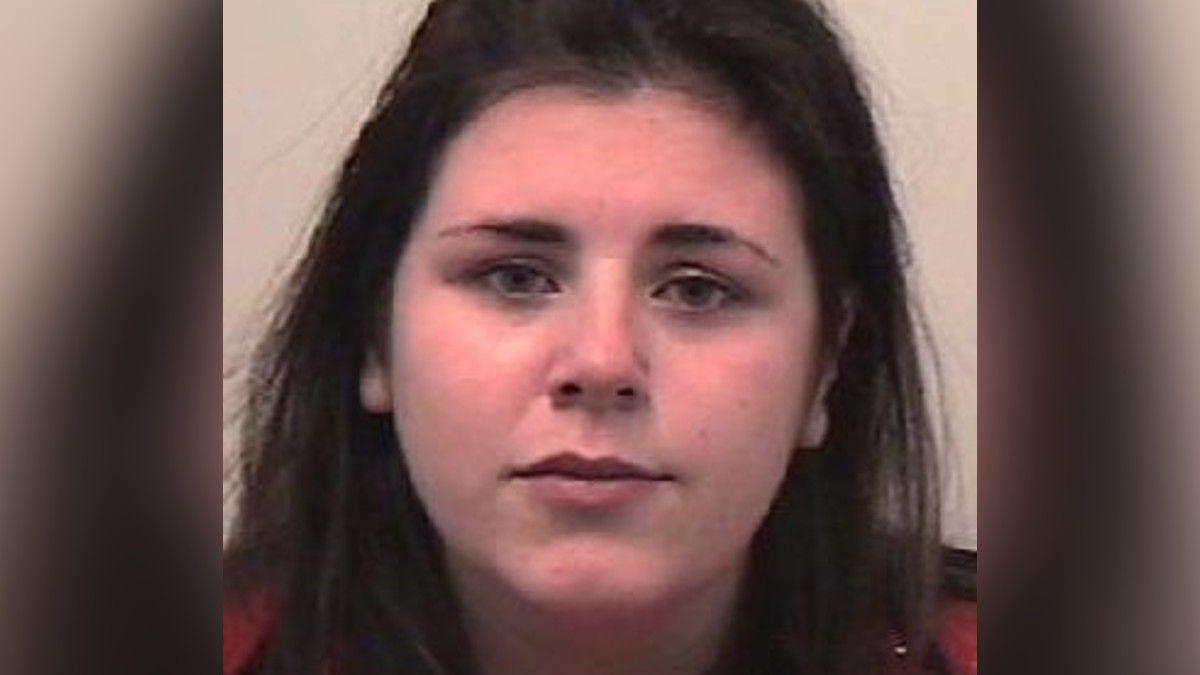
How a friend request led a beauty queen to uncover Scotland's most prolific catfish

Abbie Draper has spent a decade trying to expose an online "catfish"
- Published
Abbie Draper had experienced a whirlwind couple of years.
She was a finalist in the Miss Scotland beauty pageant, then started a new job travelling the world as an airline steward.
But in late 2014 she got a Facebook friend request that would change her life for the next decade.
She was back home in Kilmarnock to visit her grandad after he had a stroke.
The request was from a man she didn't know called David Graham, who said he was her grandfather's doctor.
Abbie said the profile picture showed "a really good-looking guy".
The profile looked genuine. David Graham had friends, posted pictures from inside the hospital and had lovely videos of his niece.
But Abbie's mum told her she had never seen him at the hospital.

Abbie says most of David Graham's victims were from the Kilmarnock area
Abbie heard from Graham again after she started a dance group and posted videos on Facebook.
The doctor said he was looking for dancers for a charity ball at a hotel in Glasgow.
Abbie agreed to take part and shared the charity ball promo he'd sent her on social media.
That's when she got a message warning her: "Whatever you do, don't trust David Graham."
Abbie was concerned but felt she needed proof – so she phoned the venue, which told her it had no record of the event.
With alarm bells ringing, Abbie set about trying to find out who David Graham really was.
A check of the doctor's register found he wasn't a medic.
So who was he? And what did he want?

Abbie turned detective to discover who the mystery doctor was
Abbie looked deeper into his Facebook profile, asked different women if they knew David Graham and started a Facebook group chat called 007.
One woman mentioned that Graham had called her while on holiday in Marbella and at one stage passed the phone to a friend called Adele.
"I didn't know who Adele was but she's a girl from Kilmarnock and she's the same age as all of us," says Abbie, who is now 35.
She went on Facebook and saw Adele's picture.
She recognised her from her grandad's hospital ward.
Adele was a nurse.
"I remember looking at it and being in such disbelief because she actually did work in the hospital and I had seen her side-by-side with my grandad," Abbie says.
"It was quite sickening."
The Beauty Queen and the Catfish
When a mysterious doctor starts flirting with a former beauty queen online, she smells a love rat.
Watch now on iPlayer
At the end of 2014, Abbie phoned the hospital to tell them a nurse was pretending to be a doctor.
They didn't believe her so she went to the police.
"I was in the police station for four or five hours," she says.
"Their words to me were: 'She's not really done anything criminal'.
"Catfishing is not a crime, they said."
The police said deceiving someone online by using a fictional persona was not criminal unless there was some other factor such as fraud, threat or intimidation.
In frustration, Abbie posted on Facebook saying David Graham was a catfish and that he was actually a woman called Adele Rennie.
Her inbox soon exploded with replies.
"There were floods of people who had all been through similar stuff or even worse," Abbie says.
"I said: 'Wow, this is bigger than I thought."

Adele Rennie was a nurse on the stroke ward where Abbie's grandad was a patient
Adele Rennie is thought to be Scotland's most prolific catfish.
As many as 100 women were affected. Some were lured in to sending intimate pictures which were used to threaten them if they cut off contact.
A three-part BBC documentary - The Beauty Queen and the Catfish - has spoken to six women who were targeted over a 15-year period.
They include Samantha, whose name has been changed at her request. She got a friend request from David Graham in 2015, quickly followed by messages talking about his day looking after patients and pictures from the hospital.
"He was a nice, chatty warm person," says Samantha.
They began speaking on the phone and soon he was sending her presents.
Flowers came every couple of weeks - all dropped off by the same woman, who Samantha got to know as Ashley.
She told Samantha that David was "such a good guy" and that she had "got a good one there".

Samantha received flowers and presents from David Graham
Samantha wanted to meet him – but he always seemed to have an excuse to avoid meeting in person.
Instead, he preferred constant phone calls. He'd phone at 6am and stay on the line for hours, then text during the day.
There were more presents and love notes.
But he'd get angry if Samantha didn't answer his messages and demanded to know where she was.
On one occasion, David agreed to meet after a concert.
When Samantha arrived she saw a woman she recognised as Ashley the florist, who told her that David had just gone to the toilet.
He never returned. They both tried phoning him, but he didn't answer.
Samantha drove Ashley home and then phoned David again.
This time he answered and apologised for missing her. He said he had bumped into friends and gone off with them.
"That's not adding up," Samantha says.
How I began to track down my catfisher
Desperate to find out what was going on, Samantha hatched a plan after David promised her a birthday gift.
She got him to deliver the present to her mother's house, then her mother waited in the dark to see who turned up.
She couldn't see who arrived with the gift, but made out the registration number of the red Corsa as it drove off.
Samantha then worked out where David parked his car near the hospital and waited for his arrival.
As the car pulled up, Samantha was speaking to David on the phone.
But when the driver got out, Samantha was shocked to see it was a woman.
"It's the florist. It sent shivers through me," she says.
The woman posing as David had been using a voice-changer app.

Abbie regrets losing the last months of her grandad's life to trying to track down Adele
Abbie's grandad, John Draper, died in 2015, which she described as "a kick in the teeth".
"All that time and effort with Adele... it consumed me for months when I should have been spending time with him."
Adele appeared to have stopped after a visit from the police, and David Graham's profile had been deleted.
But then Abbie got a message telling her the same profile was now being used on Tinder by someone calling himself Matthew Mancini.
"It wasn't just happening again, it was actually getting worse," Abbie says.
After an internal investigation at the hospital - and more cases coming to light - the police arrested Adele Rennie in November 2015.
Rennie eventually pleaded guilty to 18 charges involving 10 victims.
There were four counts of indecent communication, four of sexual coercion and 10 of stalking.
Rennie was sentenced to 22 months in prison in December 2017 and placed on the sex offenders register for 10 years.

Samantha finally discovered who David Graham actually was
The victims didn't think it was enough for what she put them through - but most of all they were all left wondering why she did it.
"All of us were pretty much left with no answers whatsoever," Abbie says.
The story was front page news and dozens more cases then came to light.
"Then I realised just how deep and dark it got with them," says Samantha.
"I sat back and was like: 'Oh wow, I got off really lightly'."
Rennie was released from prison in October 2018, but within months had come to the attention of police again.
A previous victim reported a suspicious dating profile which was traced back to Rennie.
This time she was pretending to be a wealthy lawyer and tricked women into sending her naked pictures. Rennie was jailed for another three years in 2019.

Rennie's mum Christine said she was mortified and ashamed by her daughter's crimes
Rennie's mum Christine spoke to the documentary, saying she was "mortified and ashamed" by her daughter's actions.
"I have gone through every emotion because it is just not the girl we know," she says.
"It's quite hard to accept. You don't want to believe that your child is capable of these kind of things."
When Rennie was released for a second time in May 2021, her mum felt she had turned a corner.
"She said she felt different and was looking forward to the future," says Christine.
After a couple of years she had built her life back up to a place where she was happy.
Abbie Draper was also experiencing a new chapter in her life.
She had two children and hadn't heard anything about Rennie for four years. She hoped the saga was finally over.
But then in October 2023 she got a message asking her to look at a Tinder profile.
It said: "Who do you think this sounds like?"
Tracking down a new catfish
A Facebook group called Are we dating the same guy? had been set up by women to check if a man was safe or not. Suspicions had been raised about a man who had the same profile picture as David Graham.
Abbie posted a warning about the new profile on Instagram.
"The next day Adele phones me basically saying 'why am I bringing her name up again?'," Abbie says.
"She says I have got it all wrong."
Abbie tells the documentary she did wonder if her obsession with Rennie had pushed her too far.
"Do I need to let it go? Am I trying to ruin her life?"
But she felt she had to act in case other women were in danger.
The new catfish - Callum Crolla - had posted a photo of a woman at a concert in London in an attempt to make another woman jealous.
Abbie tracked down the woman in the picture, whose name was Eilish. She had never heard of Callum Crolla.
When Eilish sent her some videos of the concert, she saw a familiar figure dancing in front of the camera.
It was Adele Rennie.
Within 24 hours Rennie had been arrested and charged with stalking, deception and sexual coercion. In July 2024 she was jailed for a third time.

Cyber psychology expert Dr Nicola Fox Hamilton said it was hard to understand this behaviour
Cyber psychology expert Dr Nicola Fox Hamilton says it is hard to understand why someone engages in this kind of behaviour.
"It is quite likely that it is early childhood experiences that are one of the major predictors of catfishing," she adds.
Rennie's mother tells the documentary that her daughter opened up about her childhood trauma when she received psychological support in prison.
Christine says her first marriage was abusive.
"He was a good enough dad but unfortunately he was a drinker so he would go on binges. I would be getting hit and things like that," she says.
"It would happen while they were in bed and I thought they were sleeping and didn't know about it."
Adele's father killed himself when she was six but her mother didn't tell her how he died.
"I did go through a guilt thing that staying in that relationship had a profound effect on her," Christine says.
"You just don't know what someone's going through and how they are going to react."
Case closed?
In January last year Adele Rennie was released from prison for the third time, having served half her sentence.
Ten days later she was arrested again. She had texted a previous victim, which was banned under the conditions of her release.
She was returned to prison for a fourth time and ordered to serve her remaining sentence plus an additional 100 days.
Rennie, who is due for release in March, provided a statement for the documentary.
She apologises and takes accountability for her wrongdoing, which she says had "resulted in innocent women being targeted and traumatised".
She says that during her current prison sentence she has accessed psychology and mental health services which have allowed her to work through her issues, including her behaviour.
"I should never have projected my inner turmoil and insecurities onto others to cause them harm... I am very sorry for my actions over the years," she says.
Abbie hopes the saga will end soon.
"People are only going to get closure when Adele stops.
"Prison doesn't give us closure, it just puts a pause on things," she says.
"I would quite like to say case closed."
Related topics
- Published18 December 2017

- Published17 June 2019
- Published30 July 2024