Indian cinema: National pride meets box office success
December 30, 2025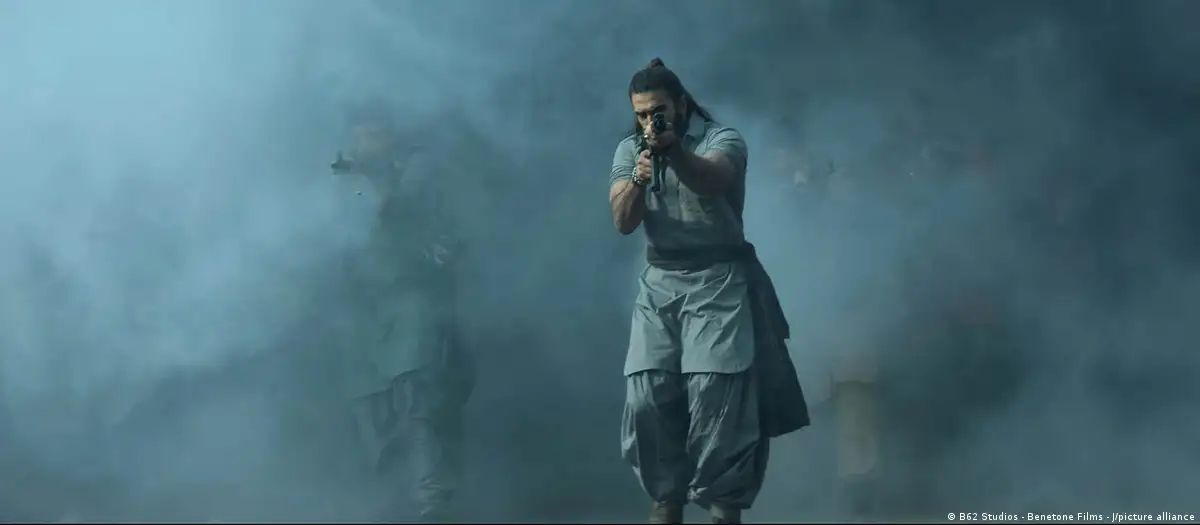
A Hindi-language spy thriller movie named "Dhurandhar" released earlier this month has become a major box office success in India, but has also divided opinions.
The 3.5-hour-long film features popular actor Ranveer Singh playing an Indian spy who infiltrates criminal networks in Pakistan's sprawling Karachi city to neutralize threats to Indian national security.
The drama is set against the backdrop of tensions between archrivals India and Pakistan, two nuclear-armed South Asian neighbors who earlier this year exchanged intense missile, drone and artillery fire for days.
The film has been a huge success at the box office and has drawn praise for its plot and action sequences.
What do critics say?
But critics say it is just the latest in a wave of films — like "The Kashmir Files," "The Kerala Story" and "Chhaava" — aiming to promote hyper-nationalist narratives.
They argue that Bollywood has been increasingly promoting the ideology of India's ruling Bharatiya Janata Party (BJP) since it came to power in 2014 and promoting politically convenient readings of history, often at the expense of nuance.
Some BJP-led state governments have also offered tax incentives for such films in recent years.
Last year, another film, "Article 370," even received praise from Prime Minister Narendra Modi. The movie endorses the government's stance on Kashmir, portraying the abrogation of the territory's semiautonomous status in 2019 as heroic and necessary to restore order and national unity.
Film critic Ishita Sengupta said filmmakers ought to be more responsible when depicting sensitive incidents in a culturally and religiously multifaceted country like India.
"When films like 'The Kashmir Files' and 'The Kerala Story' did well, it incentivized other filmmakers to tell similar stories. Numbers are proof that propaganda films have become the latest gamble in the industry. When successful, they provide extremely rich dividends," she told DW.
Shahrukh Alam, a prominent Supreme Court lawyer, criticized these movies as "lazy, state-sponsored, majoritarian filmmaking serving power for easy profits, easy money and alignment with authority."
She said these films bombard audiences with violence, invoking raw anger, resentment, fear and anxiety, leaving them without resolution or the tools to process those emotions.
"That's dangerous propaganda," she stressed, adding that "the effect is to push the targeted group into a corner" and "amplify hate speech, violence, and discrimination."
BJP rejects the criticism
But the BJP has rejected the characterization of these films as propaganda.
For the party, the movie trend represents a broader assertion of India's right to tell its own stories on its own terms.
"Why shouldn't India make films celebrating its own heroism and resilience, especially given the country's fraught history with Pakistan?" asked Shazia Ilmi, a BJP spokesperson.
To bolster her argument, Ilmi draws extensive parallels to Western cinema, where geopolitical adversaries routinely appear as villains.
"Russian antagonists populate Hollywood blockbusters. Ivan Drago in 'Rocky IV,' Ivan Vanko in 'Iron Man 2,' Viggo Tarasov in 'John Wick,' Yuri Komarov in 'A Good Day to Die Hard,' Lt. Col. Sergei Podovsky in 'Rambo.' Yet, no one calls these films propaganda or questions their legitimacy," said Ilmi, arguing that there is a double standard at play.
"Western nations are permitted and even expected to produce cinema that celebrates their military achievements, intelligence operations and national identity. When India does the same, drawing from its own historical traumas and security challenges, it is branded as propaganda and polarizing," she said.
Meanwhile, some reviewers of "Dhurandhar" have faced intense backlash.
A review by noted critic Anupama Chopra, for instance, calling the film "exhausting" with "shrill nationalism" and "too much testosterone," was removed from YouTube after a barrage of online abuse.
Dramatization and propaganda?
The crucial distinction between dramatization and propaganda lies in understanding whose ideology drives the film's narrative and what evidence supports it, said Ira Bhaskar, a former professor of cinema studies and dean at the School of Arts and Aesthetics at Jawaharlal Nehru University.
"Propaganda emerges when films brazenly espouse the ruling government's ideology as 'historical truth,'" Bhaskar told DW. "These films typically receive state support and tax exemptions."
Shubhra Gupta, a renowned film critic, said most filmmakers will never admit that they are in it only for the money, but there is no denying that cinema is a business, even if it is unlike any other, combining art and craft, mind and heart.
"Making politically skewed films, or those that channel bigotry, can be put down to both choice, expedience, or coercion — or a combination of all three," said Gupta.
"If a filmmaker's views are in sync with the regime in power, and if that regime wants to use cinema as a tool, then the alignment becomes easy," she underlined.
"The difficulty arises when coercion is used. Currently, in India, we are seeing all these elements play out."
Edited by: Srinivas Mazumdaru