Does the UK get less snow than it used to?

- Published
Many of us will remember heavy snowfall from years gone by. But does it snow as much today as it used to?
The short answer is no.
Temperatures need to be close to or below freezing for it to snow.
As our climate has got warmer due to human-induced climate change, the number of days with sleet or snow falling has reduced significantly.
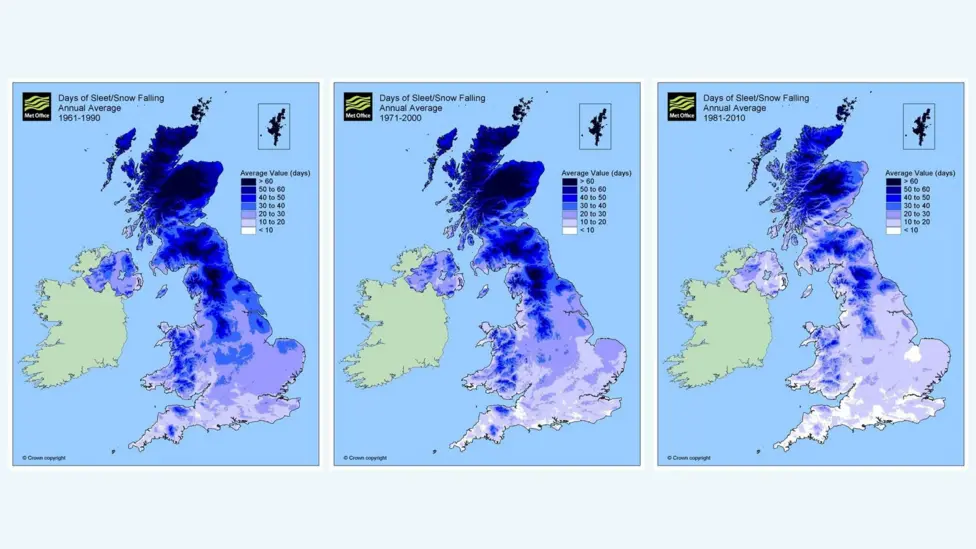
Snow is less common for most of the UK than it used to be
The change in numbers of days of snow is smallest over the tops of the Scottish mountains. Although temperatures have risen here, they are often still well below freezing when precipitation arrives. This means the increase in temperature has had less of an impact on the number of days of snow.
In fact there is a patch of snow in the Cairngorms that often survives throughout the year. Known as the Sphinx, it is thought to have melted completely on only 10 occasions in the last 300 years.
However, five of these events have been since 2017 - a sign that even the highest mountains of Scotland are not immune to the effects of our warming world.
Snowiest place in the UK
According to the Met Office, the snowiest place in the UK is Cairngorm Chairlift at an elevation of 663m (2,175ft) with 76 days of snow each year.
The snowiest lowland site is Baltasound (Shetland) with 65 days of snow on average each year.
The amount we get varies a great deal from place to place, and also from one year to the next.

Rare snow covered the beaches of St Mary's, Isles of Scilly on 28 February 2018 during the "Beast from the East" bitter cold spell
Where does it snow the least in the UK?
Cornwall is the least snowy part of the UK, with seven days of sleet or snow on average each year. But even across the county, the amount of snow will vary greatly from place to place.
Upland areas such as Bodmin Moor will see more frequent snow than relatively mild coastal areas like the Isles of Scilly, but even the latter does see snow on rare occasions, for example the extreme winters of 1946-47 and 1962-63, and the "Beast from the East" in 2018.
Why it's hard to forecast snow in the UK
Forecasting snow accurately is notoriously difficult in the UK because we are an island nation usually influenced by mild Atlantic air.
During colder winter weather a marginal change in temperature can be the difference between us having rain or snow, and even small changes in elevation across an area or city can have a large bearing on where snow will settle.
Not sure if you are set for some of the white stuff? Keep an eye on the BBC Weather app or website for the latest, or read our thoughts further ahead in our monthly outlook.
- Published25 December 2024

- Published26 December 2024

- Published11 December 2024


