Tracking Russian disinformation in Mongolia

Although it is one of the most sparsely populated countries in the world, Mongolia has a rich and complex media landscape. While diverse outlets enable readers to explore various sides of an issue, it can also provide fertile ground for foreign disinformation actors. Sandwiched between two world powers, Mongolian information systems face a unique challenge.
Russian and Chinese actors have been steadily involved in the innerworkings of Mongolian political and social life. A new study (available for download below) from the DW Akademie partner Nest Center for Journalism Innovation and Development and its subsidiary, the Mongolian Fact Checking Center, explores the avenues in which Russian disinformation in particular has found its way into discourses in Mongolia.
The unique case of Mongolia
Despite its low population density, Mongolia has one of the world’s highest levels of Internet penetration. It is also landlocked, with only two neighbors: Russia and China. As a result, Mongolia’s information landscape is both unique and offers a clear case study ofhow Russian disinformation functions.
According to DW Akademie’s Patrick Benning, the study exposes Russian strategies that it has used in other parts of the world yet are heightened due to the unique relationship Mongolia has with the two powers.
"We have not seen this level of coordination when it comes to countries of more minor significance in the region," Benning said. "Russia has the power to undermine Mongolia’s information integrity and it has since at least 2022."
Russian disinformation
When the Nest Center began exploring Russian disinformation campaigns, they focused on Facebook, Mongolia’s most used social media platform and the population’s main source of news. Russian disinformation actors are aware of this and spend much of their resources on the platform.
Senior fact-checker Bilguun Shinebayar helped edit the study and identified the main focus of disinformation activities from their northern neighbor. "Russia is involved in disinformation campaigns for one key reason: to keep Mongolia under its control and to ward off other powers," Shinebayar said in an interview with DW Akademie.
A recent example was the signing of a new investment agreement between Mongolia and France for a uranium mining project. Actors focused on spreading information and disinformation about the deal and the dangers of mining.
While this may seem like an environmental issue, said Shinebayar, it likely had little to do with concern over potential mining-related health issues. Instead, it had everything to do with the deal with France. He believes Russia sees the agreement as a threat to its sphere of influence, which also has uranium mines, and is also pushing for Mongolia to join the Russian-led Eurasian Economic Union.

Complex narratives
However, mineral rights was only one of many topics that researchers discovered when examining Russian disinformation. Other topics ranged from promoting Russia as a country, to the war in Ukraine, to the Israel-Hamas war and even to anti-Chinese rhetoric.
The study states that Russian disinformation is often employed to bolster preexisting ideas, such as pro-Russian sentiments, which are already strong in the country. At other times, the goal is to divert attention away from topics that might reflect poorly on the Russian state.
The paper specifically names four approaches used by Russian disinformation actors: firehose of falsehood (sharing multiple narratives on a variety of issues), operation doppelganger (copying trusted news sources), operation overload (sending fake requests to fact-checking organizations) and flooding the zone (creating multiple narratives to confuse a specific group and obfuscate the truth).
These different concepts, mutually reinforcing, help to erode trust in information systems and confuse the population, especially in times of uncertainty such as natural disasters, crises and elections. They sow divisions and can also breed apathy among the public.
The paper shows a distinct spike in disinformation during significant moments in Mongolian-Russian relations, most notably around Putin’s visit to the country in September 2024.

Disinformation disorder
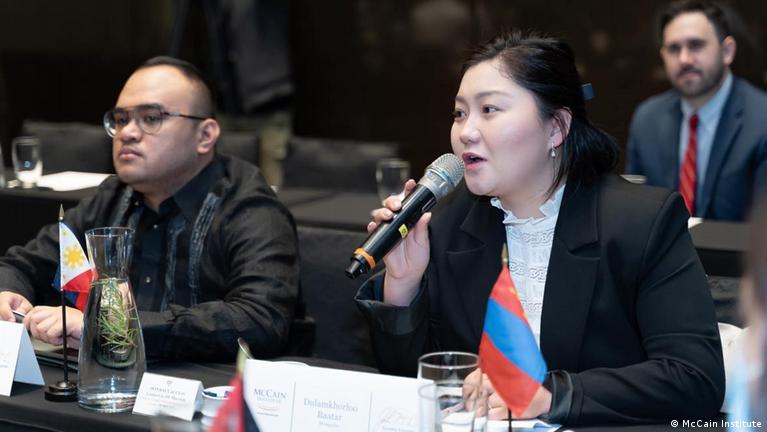
While much of the disinformation is clear in what Russia would like to accomplish, some topics are still up for debate. Dulamkhorloo (Duuya) Baatar, head of the Nest Center, has seen disinformation take many forms. She has also been the target of disinformation campaigns, with disinformation actors claiming she serves Western interests. Photos of her and Filipino Nobel Prize-winning journalist Maria Ressa have been used to disparage her and call her a foreign agent.
For Baatar, many uncertainties remain. One is why actors are preoccupied with circulating anti-vaccine disinformation online. This has had a significant and negative impact on attempts to deal with not only COVID-19, but with other diseases as well.
"We don’t know why, but making people anti-vaccine is the goal of disinformation actors," Baatar said. This has affected public health in the country. The government has tried twice – once in 2012 and then again in 2024 – to push for the HPV vaccine, which can stop the development of certain types of cervical cancer. Both times, it was met with what appeared to be concerted disinformation campaigns in the country.
"According to a recent investigation, 4000 deaths over the past decade can be connected to HPV, something that was preventable," Baatar lamented.
She it said it remains unclear whether the goal is to create real vaccine skepticism, or whether it’s just an easy hot-button issue designed to divert public attention.

Between a rock and a hard place
Russia is not the only country pushing its own agenda. To the south is China, which provides a vast majority of Mongolia’s imports. The country has its own interests and feels comfortable in wielding its influence.
For example, Baatar pointed to the Dalai Lama’s visit to Mongolia in 2016. In response, China cut off all imports. "You couldn’t even get baby formula," she said.
The study states that China’s approach to propaganda is significantly different to Russia’s. China focuses more on pro-China policies, with the goal of increasing the country’s prestige. Chinese actors communicate almost exclusively via television stations and online through official channels.

"China is focused on fostering a positive image, while Russia is looking to divert and distort," said Shinebayar.
The Mongolian government has taken a "third neighbor" approach, staying friendly and maintaining good relations with both countries. This has left some wondering just how friendly relationships are between Mongolia’s policymakers and its neighboring nations.
Baatar would like to explore this concept further. She wonders about "captures," Mongolians who spread pro-Chinese or pro-Russian propaganda not for money, but out of well-placed disinformation that has convinced them to promote and even believe false narratives. They then can then become mouthpieces for foreign governments.
"We want to look into potential elite captures at the policymaking level," said Baatar.
The Nest Center for Journalism Innovation and Development is a DW Akademie partner. The “Understanding Pro-Russian Disinformation Narratives in Mongolia” study was conducted by the Nest Center and its subsidiary the Mongolian Fact Checking Center and was supported by the German Federal Ministry for Economic Cooperation and Development (BMZ).